

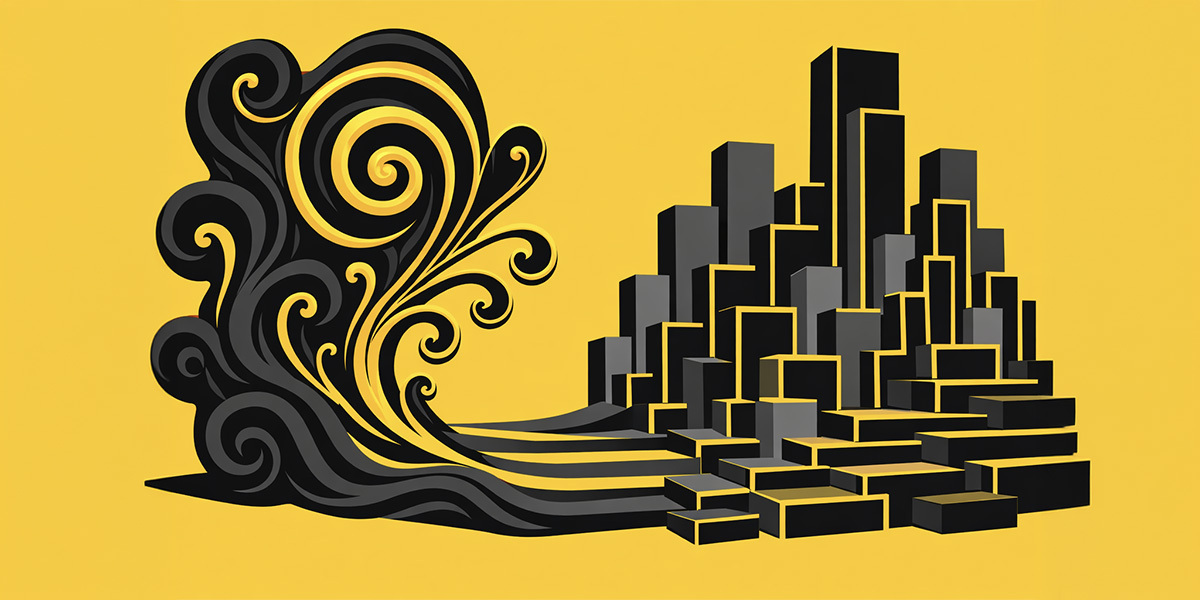
The popular story goes like this:
The truly creative person is wild, unbounded, allergic to rules. Standards are “boring.” Processes are “corporate.” Structure is the enemy.
It's a nice story.
It’s also wrong.
In practice, especially inside a growing business, structure doesn’t kill creativity.
The right structure actually amplifies it.
It gives creative energy somewhere to go. It makes sure that what you create is not just interesting once, but useful, repeatable, and aligned with where your business is headed.
Creativity and structure aren’t rivals.
They’re partners in the same system.
The Myth of the Unbounded Creative
We all know the stereotype:

The designer who
just needs space to explore.

The founder who hates
being boxed in.

The marketer who wants to
try whatever feels right.
The assumption underneath is:
"If I add structure, briefs, standards, workflows, I will get less creativity."
But think about what happens in your business when there is no structure:
That’s not creativity.
That’s chaos with nice colors.
Creativity Is Referential
We talk about “thinking outside the box” as if the box is optional.
But if there’s no box, what exactly are you outside of?
“Creative” means:
different from something, surprising within something, fresh relative to something.
A melody is creative compared to what your ear expects next.
A visual identity is creative compared to the conventions of a category or a brand’s own history.
A campaign is creative compared to previous touchpoints or to what competitors are doing.
If there are no patterns, no standards, no context, then there’s nothing to subvert, twist, remix, or reimagine. You’re not “breaking the rules”.
You’re just throwing paint.
Structure defines the box. Creativity plays with it.
The Hidden Structure Inside “Wild” Creativity



Why Boundaries Make Ideas Sharper
There’s a reason “do whatever you want” is often harder than “work within these constraints.”
When possibilities are endless, your mind has nothing to push against. Ideas stay vague and fuzzy. You hesitate, second-guess, drift. The blank infinity of options feels less like freedom and more like fog.
But give yourself a few real constraints:
this length, that medium, this mood, that theme,
and suddenly you can see.
You start making choices.
You exclude what doesn’t fit.
The work develops a spine.
That’s the gift of structure:
it introduces friction that makes your decisions meaningful.
It limits you enough that you have to be intentional.
Without any bounds, creativity collapses into impulse. Whatever you feel in the moment becomes the whole story. You might land on something beautiful, but without an internal thread or through-line, it floats on its own. It doesn’t connect to a larger body of work, a deeper question, or any kind of evolution.
It’s aesthetic fireworks:
bright for a second, gone the next.
When Structure Becomes a Cage
Of course, structure has a dark side.
It’s entirely possible to overbuild your systems, to let rules harden into dogma, to treat methods and “best practices” as sacred instead of provisional.
When that happens, creativity doesn’t just get focused; it gets squeezed out.
The problem isn’t structure itself; it’s structure that has forgotten its purpose.
If your systems no longer make room for surprise, they’re not supporting creativity, they’re defending themselves.
Living in the Tension
Too little structure, and creativity turns into scattered impulses.
Too much structure, and creativity turns into repetition and compliance.
The sweet spot is a kind of dynamic balance.
Every creative act sits on four layers, whether you name them or not.
Purpose, principles, and parameters are the structure.
Play is the creativity.
If you remove the structure, play becomes noise.
If you remove the play, structure becomes lifeless.
The art is in designing structures that are sturdy enough to give your ideas weight, and flexible enough that you can keep discovering.
What This Looks Like in Brand, CRM, and RevOps
This isn’t just a nice creative philosophy.
It’s deeply practical when you look at how your brand, CRM, and revenue operations function.
Brand
Without structure, every designer and writer reinvent your brand daily.
With only structure, your brand feels lifeless.
With structured creativity, your brand stays recognizable while constantly evolving.
CRM
A CRM like HubSpot might not feel like a creative space, but it is.
A “creative” CRM with no structure becomes a mess of fields no one understands.
An over-structured CRM with no creativity becomes a glorified address book.
RevOps
Revenue Operations is all about alignment:
brand, marketing, sales, and success working as one connected engine.
When structure and creativity are aligned across RevOps, you don’t just get “cool marketing.” You get:
Repeatable campaigns that can be improved, not just admired.
Clear insights you can act on, because your data is consistent.
Teams that feel free to test and iterate, without creating chaos for everyone else.
Making It Real on Your Team
If you want more creativity that actually moves the business forward, don’t remove structure.
Improve it.

At Morningstar Creative Solutions, we don’t treat creativity and structure as opposites.
We help you:
Clarify your brand
so everyone knows what you stand for and how to communicate it.
Design your CRM and RevOps structures
so your data is clean, your processes are clear, and your teams are aligned.
Layer on AI and automation with context
so your systems don’t just run, they learn and adapt.
The result is one connected customer engine where:
Your creative work is coherent and on-brand.
Your data is trustworthy and usable.
Your processes support experimentation instead of blocking it.
If your world feels either:
Too chaotic
“everyone is doing their own thing”
Too rigid
“we’re stuck in our own rules”
it’s a sign your creativity and structure need to be realigned.
Want help designing structures that unlock creativity instead of fighting it?
Let’s turn your brand, CRM, and RevOps into one aligned, creative, data-powered system that actually works.
